


Time:2025-11-05 Views:1 source:News
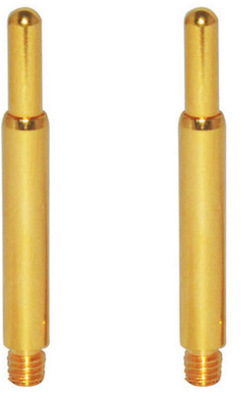
Pogopin signal output relies on the spring-loaded contact mechanism to transmit electrical signals or current, with performance determined by contact stability, impedance characteristics, and environmental factors. Unlike active components, pogopins act as passive conductors but exhibit distinct output behaviors under different working conditions.
The core output principle involves mechanical contact triggering signal transmission. When external force compresses the spring, the needle makes intimate contact with the mating surface (e.g., a PCB pad or test point), forming a conductive path for current or signals . The signal type depends on the application: in test equipment, they transmit digital test signals or analog waveforms; in consumer devices, they carry charging current or data signals (e.g., USB 3.0 data transfer) . Key output parameters include contact resistance (directly affecting signal integrity) and impedance matching (critical for high-frequency signals) .
High-frequency signal output requires optimized design to minimize loss. Premium pogopins feature 50Ω impedance matching and gold-plated surfaces to reduce signal reflection and crosstalk (NEXT/FEXT < -40dB at 10GHz), making them suitable for millimeter-wave applications . For example, in 5G base station test fixtures, pogopins maintain stable signal output up to 28GHz with negligible attenuation. In low-current scenarios (e.g., sensor signal transmission), their low contact resistance ensures minimal voltage drop (<5mV at 1mA), preserving signal accuracy .
Environmental factors influence output stability. Vibration or temperature fluctuations can cause intermittent contact, leading to signal dropouts. To mitigate this, industrial-grade pogopins use beryllium copper springs for consistent tension and nickel-gold plating for corrosion resistance, ensuring reliable output in -40°C to 85°C environments . In summary, pogopin signal output is a passive but precision-dependent process, where mechanical design and material selection directly determine transmission quality.
Read recommendations:
Customized services for magnetic connectors
Convenient installation of Pogo Pin Connector


159-2067-7287 Mr. Wan

0769-86006029

No. 5, Zhenrong Road, Wusha, Chang'an Town, Dongguan City
 Whatapp
CopyRight © 2024 Dongguan Yongtan New Energy Co., Ltd. All Rights Reserved


 CN
CN
 Home >