


Time:2026-01-07 Views:1 source:News
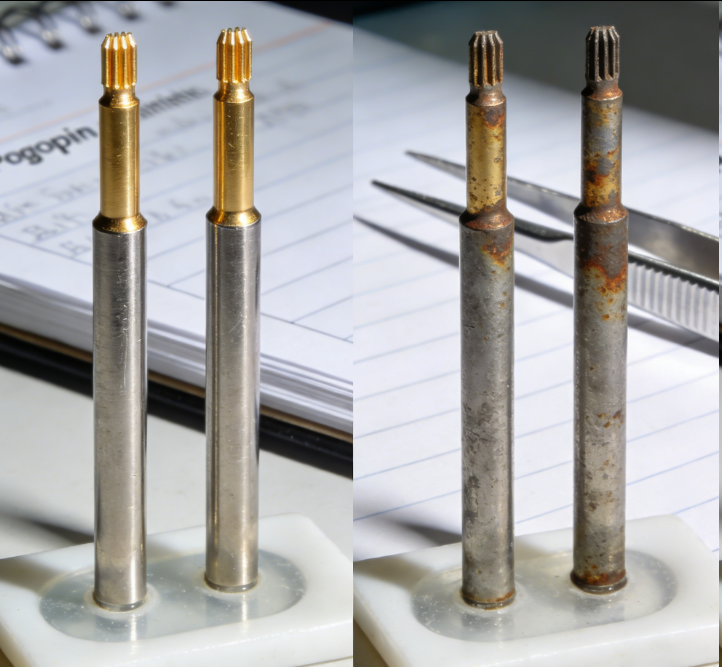
Salt spray resistance testing is a crucial evaluation for pogopin probes, especially for those deployed in harsh environments such as coastal areas, marine equipment, and some industrial settings with high humidity and salt - laden air. This testing method assesses the probes' ability to withstand corrosion caused by salt - rich atmospheres, ensuring their long - term reliability and functionality.
The salt spray test, also known as the salt fog test, replicates the corrosive effects of a salt - laden environment. It involves exposing the pogopin probes to a fine mist of saltwater solution within a specialized chamber. The standard saltwater solution typically consists of 5% sodium chloride by mass, and the test chamber maintains a controlled temperature, usually around 35°C, and a specific humidity level. This environment accelerates the corrosion process, simulating years of exposure to real - world salt - containing atmospheres in a shorter period.
Several factors influence the salt spray resistance of pogopin probes. Material selection is fundamental. Probes with housings and components made from corrosion - resistant materials, such as certain grades of stainless steel (e.g., 316L stainless steel), are more likely to endure the corrosive effects of salt spray. The surface treatment of the probe also plays a significant role. Coatings like nickel - plating, chromium - plating, or specialized anti - corrosion paints can act as a barrier, preventing direct contact between the base material and the salt - water mist. Additionally, the design of the pogopin probe can impact its salt spray resistance. Sealed designs that prevent the ingress of salt - water mist into the internal components are more resistant to corrosion.
During the salt spray test, pogopin probes are typically mounted in the test chamber for a specified duration, which can range from several hours to hundreds of hours, depending on the application requirements and industry standards. After the exposure period, the probes are thoroughly inspected. Visual inspection is carried out to check for signs of corrosion, such as rust spots, pitting, or discoloration on the surface. Electrical performance tests are also conducted to determine if the corrosion has affected the probe's contact resistance, electrical conductivity, and overall functionality. If significant corrosion or performance degradation is detected, it indicates that the probe may not be suitable for use in salt - prone environments, prompting manufacturers to improve the material, coating, or design.
In industries where pogopin probes are exposed to salt - laden conditions, passing the salt spray resistance test is a prerequisite for ensuring product reliability. For example, in marine electronics, where equipment is constantly exposed to the sea - side atmosphere, pogopin probes with high salt spray resistance are essential to maintain stable electrical connections over time. By subjecting pogopin probes to rigorous salt spray testing, manufacturers can develop products that meet the demanding requirements of various harsh environments, enhancing the overall quality and durability of electronic devices.
High - Frequency Performance of Pogopin Probes
In the era of high - speed data transmission and wireless communication, the high - frequency performance of pogopin probes has become increasingly critical. These probes are often used in applications such as 5G communication devices, high - speed data interfaces, and microwave systems, where maintaining signal integrity and minimizing signal loss at high frequencies are essential.
At high frequencies, the electrical characteristics of pogopin probes change significantly compared to low - frequency operations. One of the key aspects affecting high - frequency performance is the impedance matching of the probe. Impedance is the opposition that the probe presents to the flow of alternating current at high frequencies. If the impedance of the pogopin probe does not match that of the connected circuit or transmission line, signal reflections will occur, leading to signal degradation and reduced transmission efficiency. To address this, manufacturers design pogopin probes with precise impedance control, often through careful selection of materials and optimization of the probe's geometry, such as the diameter of the housing and the length of the plunger.
Another important factor is the parasitic capacitance and inductance within the pogopin probe. At high frequencies, these parasitic elements can have a significant impact on signal propagation. Parasitic capacitance can cause signal attenuation and phase shift, while parasitic inductance can lead to impedance mismatches and signal distortion. Advanced design techniques, such as using low - dielectric - constant materials for insulation and optimizing the internal structure to minimize the length of current paths, are employed to reduce the effects of parasitic capacitance and inductance. Additionally, the contact resistance of the pogopin probe at high frequencies needs to be kept low. The quality of the contact surfaces, including the plating materials and surface finish, plays a crucial role in maintaining low contact resistance and ensuring stable signal transmission.
Testing the high - frequency performance of pogopin probes requires specialized equipment. Vector network analyzers (VNAs) are commonly used to measure parameters such as impedance, insertion loss, return loss, and phase shift across a wide range of frequencies. These measurements help engineers evaluate how well the pogopin probe performs at high frequencies and identify areas for improvement in the design. In addition, time - domain reflectometry (TDR) can be used to analyze the signal integrity of the probe by observing the reflection of a high - speed pulse signal. By continuously researching and optimizing the design and manufacturing processes based on high - frequency performance test results, manufacturers can develop pogopin probes that meet the stringent requirements of modern high - frequency electronic applications, enabling reliable and efficient high - speed data transmission.
Noise Level of Pogopin Probes
The noise level of pogopin probes is an important performance parameter, especially in applications where signal purity and low - noise operation are required, such as in audio equipment, precision measurement instruments, and high - sensitivity sensors. Noise in pogopin probes can interfere with the normal electrical signals, leading to signal distortion, reduced accuracy, and degraded performance of the overall system.
There are several sources of noise in pogopin probes. One of the main sources is electrical contact noise, which occurs at the interface between the plunger and the mating connector. Imperfections in the contact surfaces, such as rough surfaces, oxidation layers, or contaminants, can cause fluctuations in the contact resistance, resulting in electrical noise. The mechanical movement of the plunger within the housing can also generate noise. For example, vibrations or friction between the plunger and the housing walls can induce electrical noise through electromagnetic coupling or mechanical - to - electrical conversion. Additionally, environmental factors, such as electromagnetic interference (EMI) from nearby electronic devices or power sources, can couple into the pogopin probe and increase the noise level.
To reduce the noise level of pogopin probes, manufacturers adopt various strategies. Improving the quality of the contact surfaces is crucial. Using high - purity metals with excellent electrical conductivity and applying advanced plating techniques, such as gold plating with a smooth and uniform finish, can minimize contact resistance fluctuations and reduce contact noise. Optimizing the mechanical design of the probe to reduce vibrations and friction is also effective. For example, using precision - machined components with tight tolerances and incorporating shock - absorbing or vibration - dampening features can lower the mechanical - induced noise. Shielding the pogopin probe from external electromagnetic interference is another important measure. This can be achieved by using shielded housings or incorporating electromagnetic shielding materials around the probe.
Measuring the noise level of pogopin probes typically involves using sensitive electrical measurement instruments, such as oscilloscopes and spectrum analyzers. These instruments can detect and analyze the noise signals within the probe over a specific frequency range. By carefully characterizing the noise sources and levels, engineers can develop more effective noise - reduction strategies and ensure that pogopin probes meet the low - noise requirements of different applications. In applications where high - precision signal transmission is essential, minimizing the noise level of pogopin probes is key to maintaining the reliability and performance of the entire electronic system.
Power Loss of Pogopin Probes
Power loss in pogopin probes is a significant consideration, particularly in applications where energy efficiency and power management are crucial, such as in battery - powered devices, high - power electrical systems, and data centers. Understanding and minimizing power loss can improve the overall performance, extend the operating life of devices, and reduce energy consumption.
Several factors contribute to power loss in pogopin probes. Contact resistance is one of the primary culprits. When electrical current flows through the pogopin probe, the resistance at the contact interface between the plunger and the mating connector causes power to be dissipated as heat. Even a small increase in contact resistance can lead to significant power loss, especially in high - current applications. The material properties of the contact surfaces, such as their conductivity and oxidation resistance, play a vital role in determining the contact resistance. Additionally, the quality of the contact, including the contact area and the contact pressure, affects power loss. A larger contact area and appropriate contact pressure can reduce contact resistance and, consequently, power loss.
Another source of power loss is the internal resistance of the pogopin probe components, such as the housing and the spring. Although these components are designed to have low resistance, they still contribute to power loss, especially when a large amount of current passes through the probe. The design of the probe, including its geometry and the cross - sectional area of the conductive paths, can be optimized to minimize this internal resistance. For example, using materials with higher electrical conductivity for the housing and spring and increasing the cross - sectional area of the components can reduce power loss due to internal resistance.
Eddy current losses can also occur in pogopin probes, especially at high frequencies. Eddy currents are induced circulating currents within conductive materials due to changing magnetic fields. These currents generate heat and cause power loss. To mitigate eddy current losses, manufacturers may use materials with high electrical resistivity or design the probe in a way that reduces the magnetic field coupling within the components.
Measuring power loss in pogopin probes involves techniques such as electrical power measurement using power meters or analyzing the heat generated by the probe using thermal imaging cameras. By accurately quantifying the power loss, engineers can identify the main sources of loss and implement strategies to reduce it. In applications where power efficiency is critical, minimizing the power loss of pogopin probes not only helps to save energy but also improves the reliability and performance of the electronic devices in which they are used.
Read recommendations:
Magnetic PogoPin Consumer Electronics Supplier


159-2067-7287 Mr. Wan

0769-86006029

No. 5, Zhenrong Road, Wusha, Chang'an Town, Dongguan City
 Whatapp
CopyRight © 2024 Dongguan Yongtan New Energy Co., Ltd. All Rights Reserved


 CN
CN
 Home >